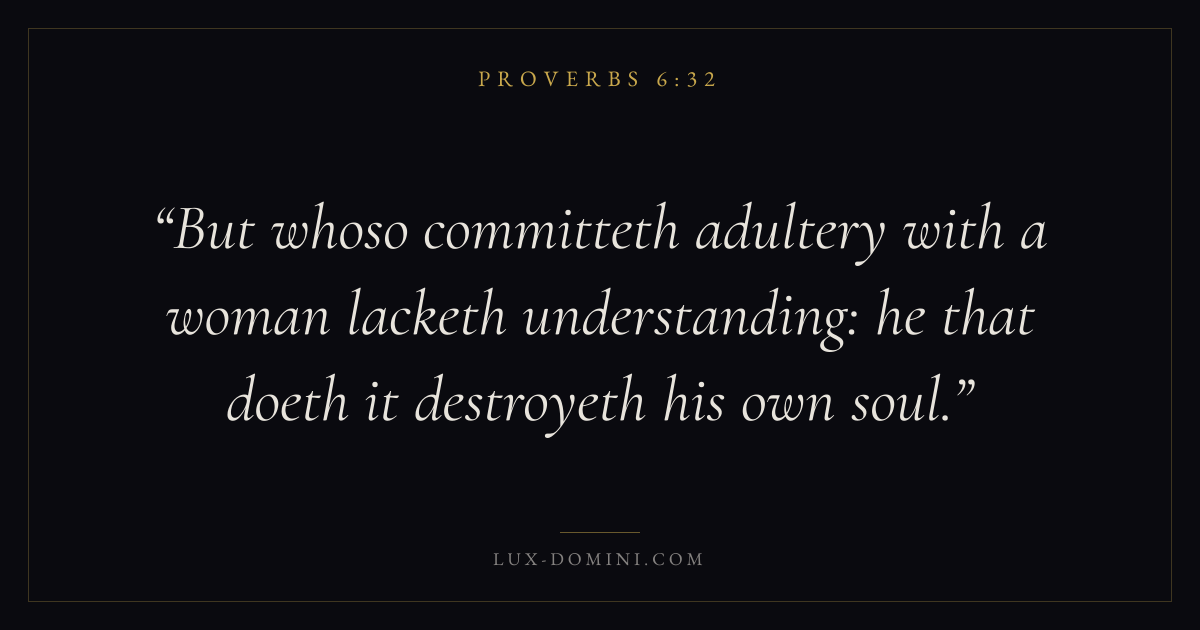
But whoso committeth adultery with a woman lacketh understanding: he that doeth it destroyeth his own soul.
What does Proverbs 6:32 mean?
The word of God has something to say to us upon all occasions. Let not faithful reproofs ever make us uneasy.
Key themes
Read with
Keep this verse inside Proverbs 6:30-32 and alongside a few nearby related passages.
Commentary on Proverbs 6:32
But whoso committeth adultery with a woman,.... Which is a greater degree of theft than the former, it being the stealing of another man's wife; lacketh understanding; or "an heart" (t); the thief lacks bread, and therefore steals, but this man lacks wisdom, and therefore acts so foolish a part; the one does it to satisfy hunger, the other a brutish lust; he that doeth it destroyeth his own soul; is liable to have his life taken away by the husband of the adulteress; so according to Solon's law (u) the adulterer taken in the act might be killed by the husband: or by the civil magistrate; for according to the law of.
Key words
- whoso
-
But whoso committeth adultery with a woman,.
- committeth
-
But whoso committeth adultery with a woman,.
- adultery
-
But whoso committeth adultery with a woman,.
Context in Proverbs 6
Show chapter context
Proverbs 6 belongs to the early movement of the book, especially the section often described as fatherly discourses on wisdom. Proverbs offers compact instruction on speech, work, wealth, friendship, sex, discipline, justice, and wisdom as a way of life before God. Read this chapter with the wider themes of wisdom, fear of the Lord, and speech in view so the individual verses keep their proper weight.
Related topics
Explore by topic
Bible verses about anxiety and fear
Verses for readers searching for biblical language about fear, worry, troubled thoughts, and the call to trust God under pressure.
Verses on the fear of the Lord, wise speech, practical judgment, teachability, and the difference between biblical wisdom and mere cleverness.
Bible verses about justice and mercy
Key texts on public righteousness, neighbor-love, social ethics, compassion, and the prophetic refusal to separate worship from justice.
Passages on the nature of truth, honesty, deception, the word of God as truth, and Jesus' claim to be the truth.