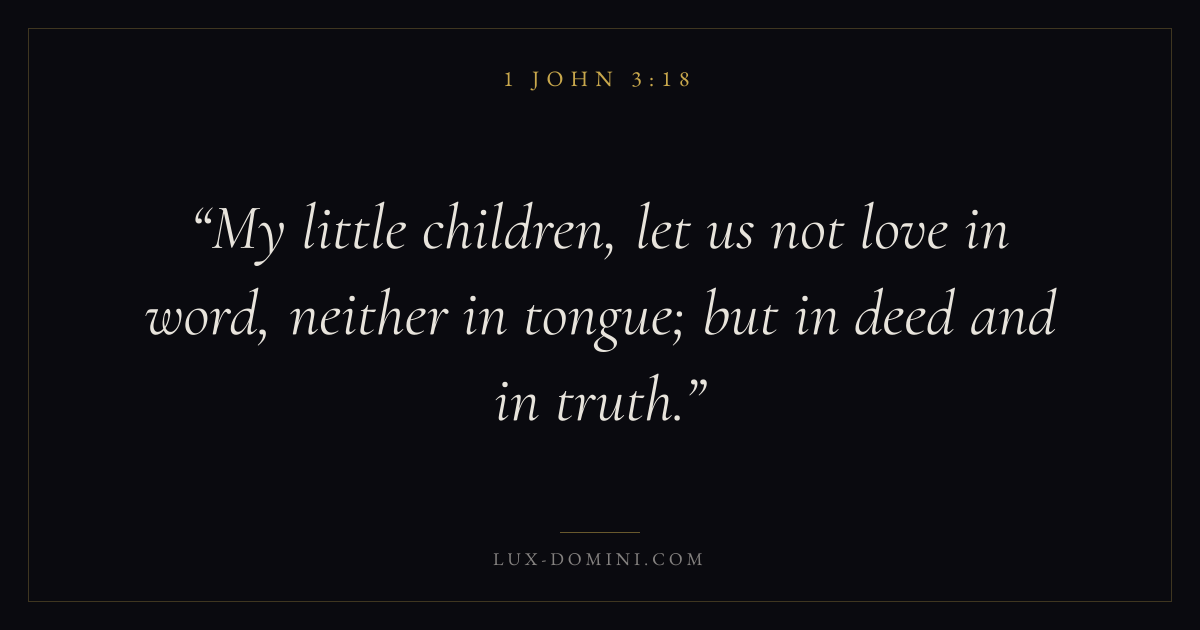
My little children, let us not love in word, neither in tongue; but in deed and in truth.
What does 1 John 3:18 mean?
Here is the condescension, the miracle, the mystery of Divine love, that God would redeem the church with his own blood. Surely we should love those whom God has loved, and so loved.
Key themes
Read with
Keep this verse inside 1 John 3:18-20 and alongside a few nearby related passages.
Commentary on 1 John 3:18
My little children, let us not love in word, neither in tongue - By mere profession; by merely sayin G that we love each other. See 1 Peter 1:22 . But in deed and in truth - In such acts as shall show that our professed love is sincere and real. Let us do the deed of love, whether anything is said about it or not. See the notes at Matthew 6:3 .
Key words
- little
-
My little children, let us not love in word, neither in tongue,.
- children
-
My little children, let us not love in word, neither in tongue,.
- word
-
My little children, let us not love in word, neither in tongue,.
Context in 1 John 3
Show chapter context
1 John 3 belongs to the middle movement of the book, especially the section often described as love and discernment. First John is a profound epistle of light, truth, love, assurance, obedience, and confession of the incarnate Son. Read this chapter with the wider themes of love, truth, and assurance in view so the individual verses keep their proper weight.
Related topics
Explore by topic
A guided collection of passages on God’s love, neighbor-love, steadfast covenant love, and the shape of love in Christian life.
Central texts on sin, grace, faith, Christ’s saving work, and the Bible’s announcement that salvation is received rather than achieved.
Passages on the nature of truth, honesty, deception, the word of God as truth, and Jesus' claim to be the truth.