And, ye fathers, provoke not your children to wrath: but bring them up in the nurture and admonition of the Lord.
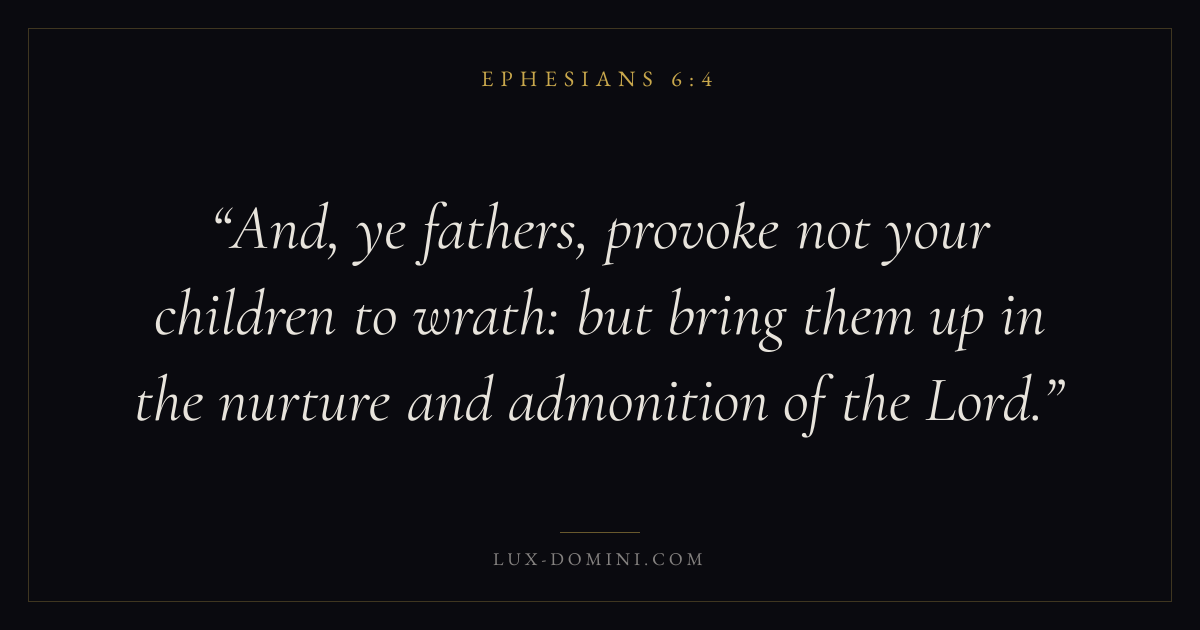
What does Ephesians 6:4 mean?
The great duty of children is, to obey their parents. That obedience includes inward reverence, as well as outward acts, and in every age prosperity has attended those distinguished for obedience to parents.
Key themes
Read with
Keep this verse inside Ephesians 6:1-4 and alongside a few nearby related passages.
Commentary on Ephesians 6:4
And ye fathers - A command addressed particularly to "fathers," because they are at the head of the family, and its government is especially committed to them. The object of the apostle here is, to show parents that their commands should be such that they can be easily obeyed, or such as are entirely reasonable and proper. If children are required to "obey," it is but reasonable that the commands of the parent should be such that they can be obeyed, or such that the child shall not be discouraged in his attempt to obey. This statement is in accordance with what he had said Ephesians 5:22-25 of the relation of husband and wife.
Key words
- fathers
-
And ye fathers, provoke not your children to wrath,.
- provoke
-
And ye fathers, provoke not your children to wrath,.
- children
-
And ye fathers, provoke not your children to wrath,.
Context in Ephesians 6
Show chapter context
Ephesians 6 belongs to the closing movement of the book, especially the section often described as household life and spiritual warfare. Ephesians presents the church as Christ’s body and temple, chosen in grace, united across dividing walls, and called to mature holy life. Read this chapter with the wider themes of union with Christ, church, and grace in view so the individual verses keep their proper weight.
Related topics
Explore by topic
Key passages on households, parenthood, children, mutual responsibility, and the way family life is placed under the Lord’s claim.
Honoring passages for Father’s Day, cards, and gifts — verses on the role of fathers, godly instruction, and the fatherhood of God as a model.
Key passages on God's unmerited favour, the grace of Christ, salvation by grace through faith, and how grace transforms the way believers live.