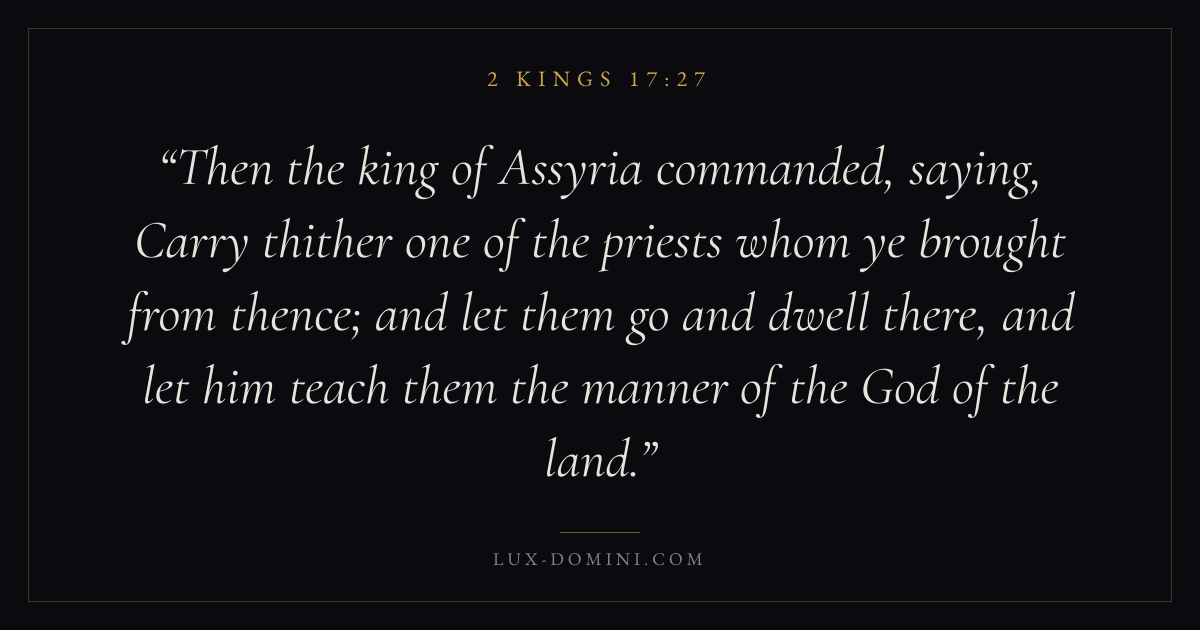
Then the king of Assyria commanded, saying, Carry thither one of the priests whom ye brought from thence; and let them go and dwell there, and let him teach them the manner of the God of the land.
What does 2 Kings 17:27 mean?
The terror of the Almighty will sometimes produce a forced or feigned submission in unconverted men; like those brought from different countries to inhabit Israel.
Key themes
Read with
Keep this verse inside 2 Kings 17:24-28 and alongside a few nearby related passages.
Commentary on 2 Kings 17:27
Carry one of the priests ...; let them go and dwell there, and let him teach - The double change of number is curious; but rise text needs no emendation. The priest would require to be accompanied by assistants, who would "go and dwell," but would not be qualified to "teach." The arcana of the worship would be known to none excepting the priests who had ministered at the two national sanctuaries of Dan and Bethel.
Key words
- Assyria
-
Then the king of Assyria commanded, saying,.
- commanded
-
Then the king of Assyria commanded, saying,.
- saying
-
Then the king of Assyria commanded, saying,.
Context in 2 Kings 17
Show chapter context
2 Kings 17 belongs to the middle movement of the book, especially the section often described as decline of Judah. Second Kings follows the ministries of Elijah and Elisha, recounts the decline of both kingdoms, and ends with Jerusalem’s fall and a faint glimmer of Davidic continuity. Read this chapter with the wider themes of prophetic witness, judgment, and exile in view so the individual verses keep their proper weight.
Related topics
Explore by topic
A collection of passages on hope under pressure, future inheritance, resurrection expectation, and confidence in God’s final faithfulness.
Bible verses about anxiety and fear
Verses for readers searching for biblical language about fear, worry, troubled thoughts, and the call to trust God under pressure.
Bible verses about justice and mercy
Key texts on public righteousness, neighbor-love, social ethics, compassion, and the prophetic refusal to separate worship from justice.
Passages on the nature of truth, honesty, deception, the word of God as truth, and Jesus' claim to be the truth.